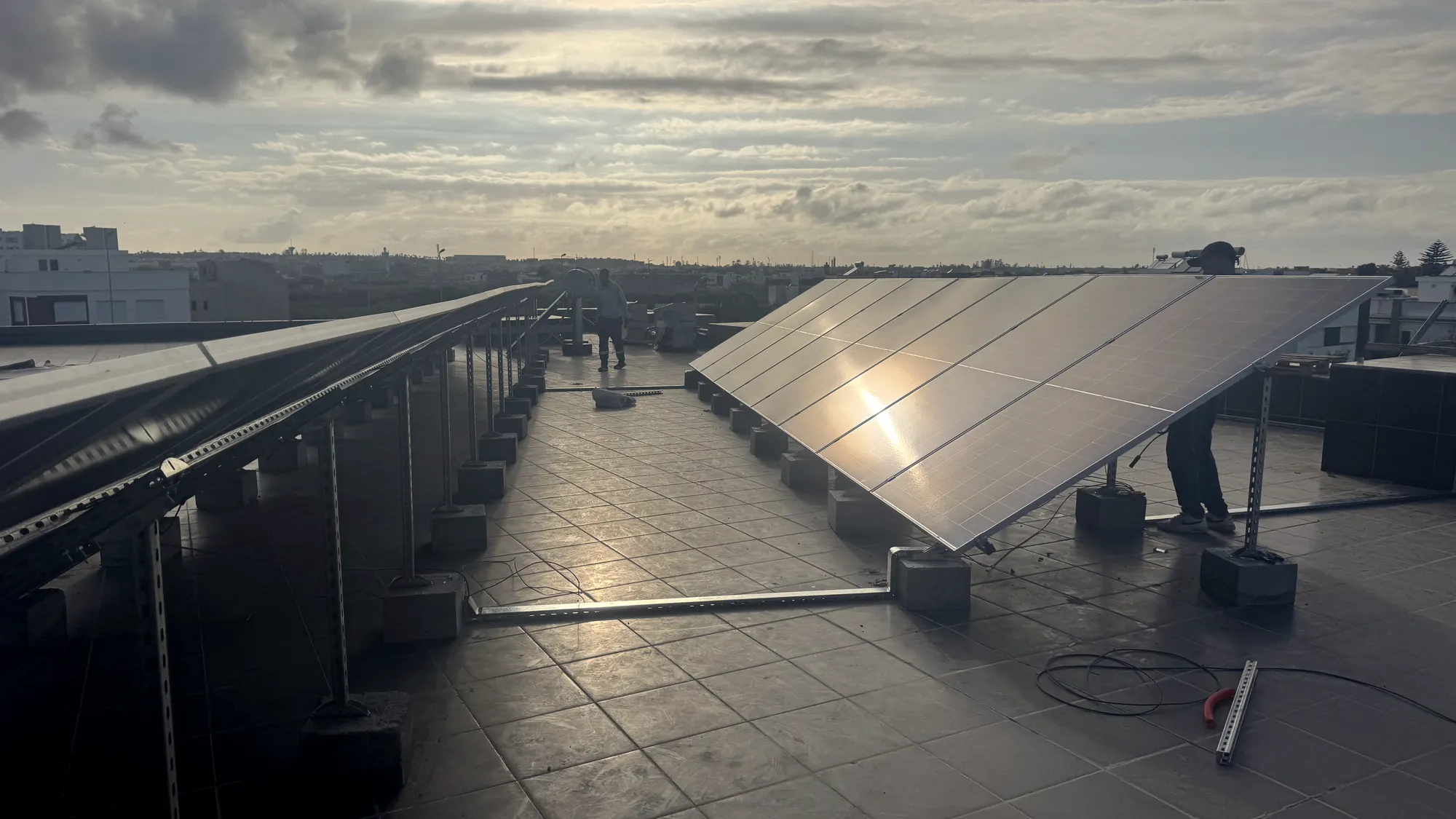
Warehouse · agro-industrial · retail · public sites
Your electricity cost line — you can steer it instead of enduring it
On a business site, solar isn't a showpiece: it's a production asset that delivers for more than twenty years. The sizing, though, starts from your bills and your activity rhythm, hour by hour — the measured curve if your distributor supplies it — not from a template.
- +20 years
- Of production
- 5 MW
- Authorisation threshold
Where do you see yourself?
Four site types, one load logic
01
Warehouse / plant
Every kWh enters the cost price of a manufactured part. A wide, flat roof produces exactly when the machines are running — production lands when demand is there.
- Financial line
- An operating cost that becomes a depreciated asset
- Technical line
- Wide, flat roof · install with no production stoppage
02
Agro-industrial shed
Drying, cold storage, processing: an agricultural shed consumes in broad daylight, exactly when the sun gives. The roof, already there, costs nothing extra to use — it carries the panels without eating a square metre of ground.
- Financial line
- Zero extra land tied up — the existing roof funds the structure
- Technical line
- Galvanised steel structure, 20-year warranty · no ground surface lost
Warranty: galvanised steel structure, 20 years, mounted on the existing roof
03
Retail / hospitality
Air conditioning in the afternoon, laundry in the morning, pool pumps running non-stop: a shop or hotel's curve hugs the sun's, hour for hour. Solar comes to cap a cost item that climbs every season.
- Financial line
- Caps a cost line that climbs every tourist season
- Technical line
- Consumption curve tracks sunshine, hour for hour
04
Public sites
A public building or clinic tolerates no outage. Hybrid inverters plus batteries hold the critical equipment through grid dips, and by day the bill drops on the rest of the building.
- Financial line
- Lowers the building bill while securing continuity of service
- Technical line
- Hybrid inverters + batteries · continuity on critical equipment
Warranty: Deye/Huawei hybrid inverters, 10 years
Financing
Cash purchase or a written financing offer
No figure is published here: the costing of a business site comes out of the study, never out of an average. Financing terms are handed to you in a written offer, to be read before you sign; institutions and rates appear on theFinancing & returns page once verified.
Cash purchase or a written financing offer: what changes structurally
| Criterion | Cash purchase | Written financing offer |
|---|---|---|
| Who owns the installation | Your company, from commissioning | As set out in the written offer you receive — read it before signing |
| Who books the depreciation | Your company, as a fixed asset on its balance sheet | As set out in the offer; your accountant confirms the treatment |
| Day-one cash impact | Immediate cash outflow | Depends on the offer — the detail is on the Financing page |
What your procurement team checks
IEC 61215 / 61730
Modules certifiés
Loi 82-21
Autoconsommation BT
30 ans
Garantie performance panneaux
10 ans
Garantie onduleur
Law 82-21 · medium voltage
The saving comes from self-consumption
Law 82-21 sets the framework for self-generation: your saving comes from what you consume on site. Any surplus is capped at 20 % of annual production (law 82-21 art. 12, ANRE decision 04/26). It is paid 18 cDH/kWh off-peak and 21 cDH/kWh at peak, excluding taxes, in MV/HV/EHV only (period 01/03/2026 to 28/02/2027, indexed). In low voltage, resale is not open.
Which law 82-21 regime your site falls under
Power decides (decree 2.25.100): a declaration below 11 kW; a connection agreement from 11 kW to under 5 MW, in low or medium voltage, filed with the distributor; an authorisation from 5 MW. For the connection agreement as for the authorisation, we assemble the technical file and carry it through to commissioning.
Written warranties
From 2 to 30 years, in black and white
Plus real-time production monitoring, with client access included on every installation.See all our warranties →
- 12 years
- Panel product
- 30 years
- Performance ≥ 87.4 %
- 10 years
- Inverter & battery
- 20 years
- Steel structure
- 2 years
- Taqinor labour
FAQ
Frequently asked questions — business solar
Maintenance frequency
Does a business site need particular maintenance?
Real-time production monitoring covers your site and triggers an alert on our side before you notice anything. A scheduled maintenance visit can be added as a contract; the response time is set by your contract. See the Maintenance & monitoring page.
How the price is calculated
How is the price for a business site calculated?
The costing is set on your bills and your activity rhythm, hour by hour (the measured curve if your distributor supplies it), and on your grid-connection conditions, never on a generic template. No figure is published on this page: the real quote depends on the technical visit and on the applicable law 82-21 regime (declaration below 11 kW; connection agreement from 11 kW to under 5 MW; authorisation from 5 MW).
What’s included / excluded
What is included in a business installation?
Tier-1 equipment (panels, inverter, structure), the full technical file, building the law 82-21 file (grid-connection agreement or authorisation depending on power) and real-time production monitoring access for your site.
What is not covered by the warranty?
Accidental damage or an external impact, an intervention by a third party not authorised by Taqinor, a clear lack of maintenance, a force-majeure event (a matter for the building’s insurance, not our hardware warranty) and normal wear beyond the guaranteed thresholds. Indicative list, to be confirmed — see the Warranties page.
Timelines
What is the timeline from first contact to commissioning?
The same three-step process as a residential site: initial assessment, direct exchange with a technician, then the technical visit and full assessment. On a business site, the assessment also factors in your bills and your activity rhythm and, depending on power, building the law 82-21 file — which can extend the timeline depending on the applicable regime (grid-connection agreement or authorisation).
Warranties
What warranties cover a business installation?
The same tier-1 warranties as residential: panels 12 years product / 30 years linear performance (≥ 87.4 %), inverter 10 years, galvanised steel structure 20 years, Taqinor installation and labour 2 years. The breakdown by component is below and on the Warranties page.
Warranties by component
What type of site do you have?
Free study
A question about your site before you commit? Talk to a human.
WhatsApp direct with an advisorFree · No obligation · Reply within 24–48 h · On WhatsApp